The UK MiFID Rewrite
FCA Predicts Savings. Industry Remains Skeptical.
 Author:
Michelle Zak
Author:
Michelle Zak

Managing Director
23 February 2026
The FCA’s proposed UK MiFID rewrite promises material cost savings and a streamlined reporting framework. However, industry sentiment suggests a more cautious outlook. Drawing on market feedback and regulatory analysis, this article explores the differences between projected efficiencies and practical implementation challenges.
The Financial Conduct Authority’s (FCA) Consultation Paper (CP25/32) proposes the most significant overhaul of the UK transaction reporting regime since its introduction in 2018.
By its own account, the FCA is predicting that these changes will ultimately save the industry around one-quarter (25%) of firms’ current annual transaction reporting costs.
However, a recent industry poll conducted by Qomply suggests the market is hesitant to bank on these savings just yet.
Qomply polled over 250 industry practitioners, across the buyside and sellside, and the data reveals a stark gap between regulatory intent and operational reality.
The Verdict: “Too Early to Tell”
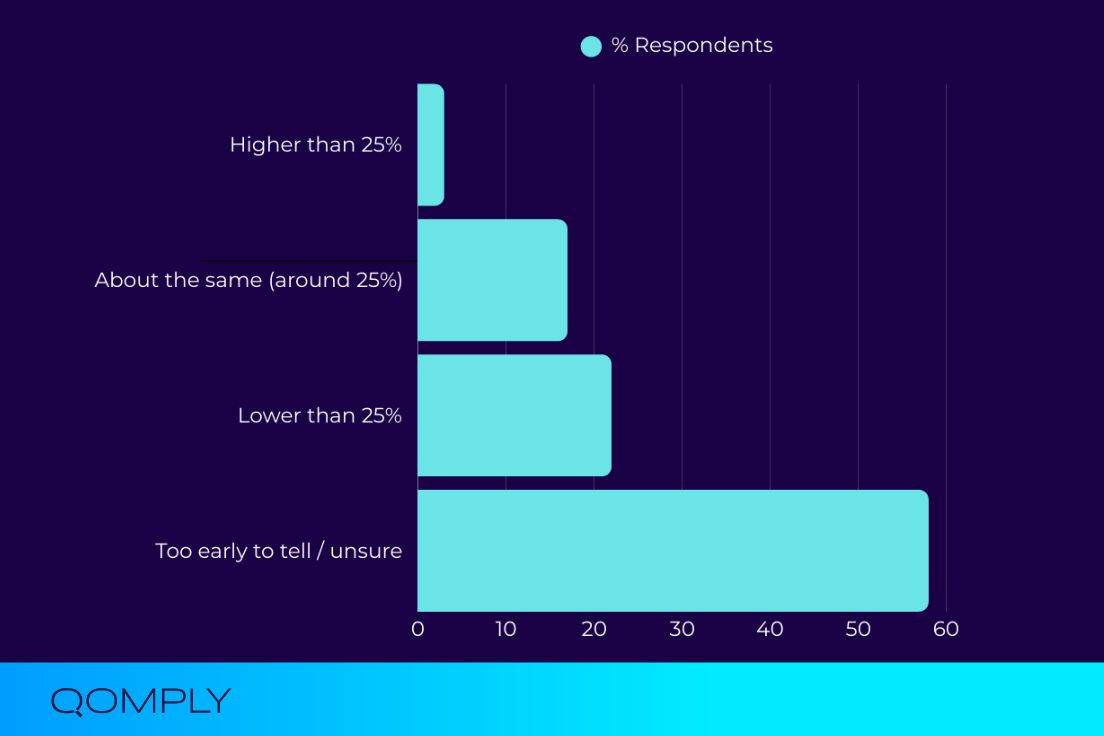
Despite the FCA’s estimate, the industry is cautious. When asked if they anticipated savings around 25%,
- 58% of respondents stated it was “too early to tell” or were unsure.
- Only 3% believed savings would be higher than 25%.
- 22% actually predicted savings would be lower than the regulator’s estimate.
This scepticism likely stems from the “cost of change.” While the end state, reporting on fewer instruments, is leaner, the transition requires significant upfront investments to untangle legacy systems.
Question: The FCA estimates that the proposed measures in CP25/32 could deliver cost savings equivalent to around one-quarter of firms’ current
annual transaction reporting costs.
Do you think the actual savings for your organisation will be…
The Knowledge Gap is the Primary Challenge
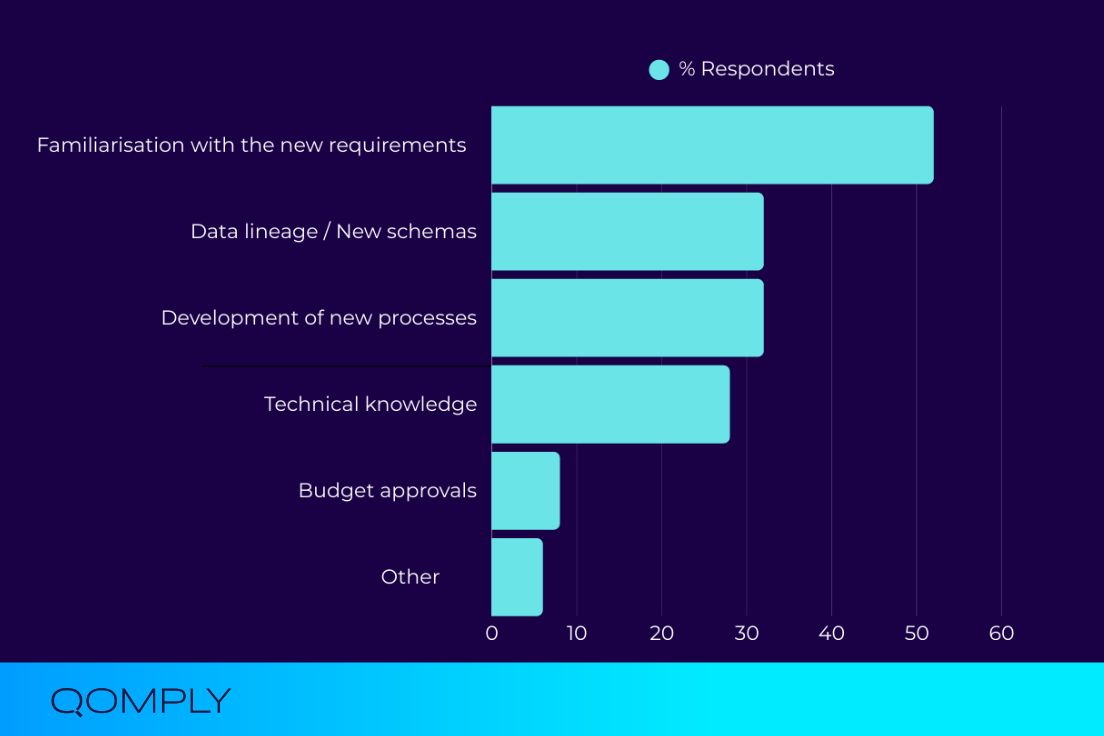
The poll identified that the single biggest hurdle for implementation is not technology, but interpretation of the potential guidelines.
- 52% of respondents cited “Familiarisation with the new requirements” as their biggest challenge.
- This was followed by “data lineage/New schemas” (32%) and “Development of new processes” (32%).
This signals a need for subject matter expertise. CP25/32 introduces significant complexity, including the new Conditional Single-Sided Reporting Model and a battery of additional data fields. Many of these fields may require changes to IT systems, and their interpretation requires regulatory analysis before implementation can begin.
Question: What is the biggest challenge you expect to face in implementing the new regime? (Multiple choice)
IT and Data Lineage: The Hidden Costs
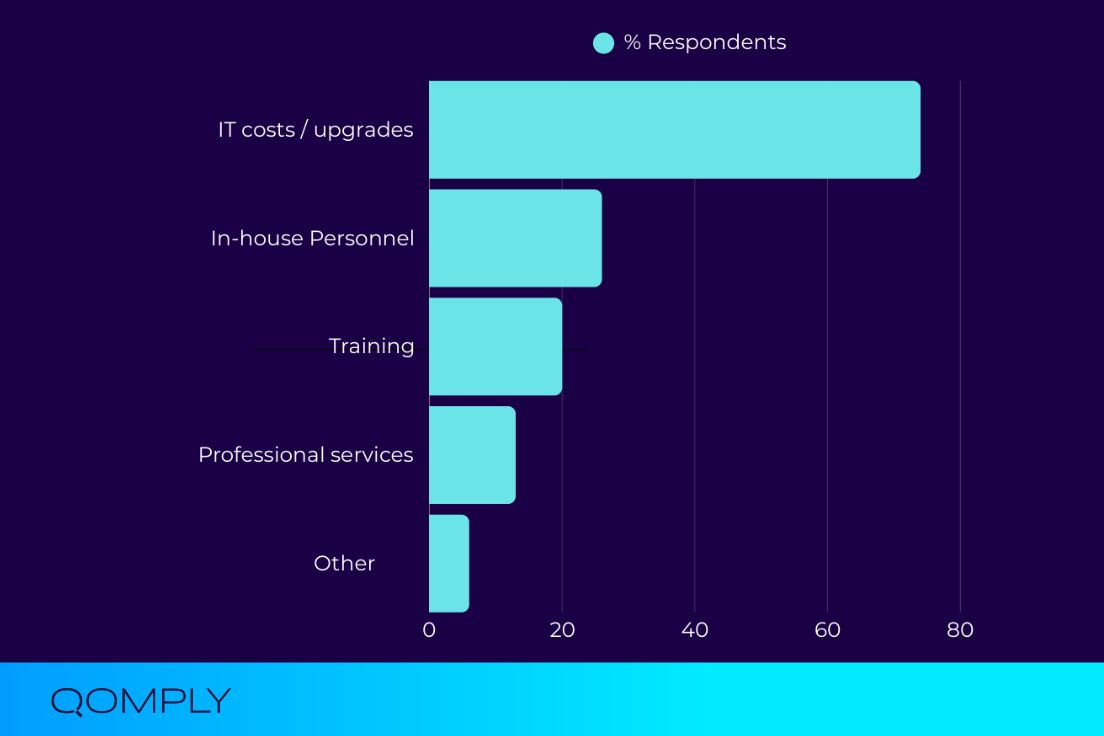
Once the rules are understood, the focus shifts to execution. A massive 74% of respondents identified IT costs/upgrades as their biggest expected implemented cost.
This aligns with the need for what Qomply calls “Operational Intelligence.” Firms are realising that adapting to the UK MiFID rewrite will require more than just updating fields.
Question: What do you feel the biggest implementation costs will be? (Multiple choice)
The Bottom Line
The UK MiFID rewrite offers a potential path to savings on transaction reporting, but the path remains unclear and complex. As the poll results indicate, the majority of firms are waiting for more clarity before they accept the regulator’s savings projection as fact.
The final revisions to MiFID are expected later this year. Once the FCA formalises the requirements, Qomply will work closely with clients to support a smooth transition. In addition to providing a dedicated UAT environment, we will proactively highlight the data fields that are expected to change as well as new rules that will highlight upcoming changes that may be required in their reporting.
This approach is designed to give firms early visibility of potential gaps within their current MiFID reporting and a clear understanding of the enhancements that may be required ahead of the switchover. By sharing insight as the framework develops, we aim to help clients prepare in a structured and informed way.

Key Takeaways
- The FCA expects cost savings from the UK MiFID rewrite, but many firms remain skeptical about the scale and timing of those efficiencies.
- Implementation complexity is being underestimated, particularly around data sourcing, mapping logic and systems changes.
- Knowledge gaps pose a material risk, with many firms unsure how the new framework will affect their reporting controls.
- Governance and quality assurance will be critical to avoid post-implementation remediation and regulatory scrutiny.
- Early preparation reduces risk, especially where trade capture, reconciliation and backreporting processes may require redesign.