Regulatory Reporting | CFTC Transaction Reporting

About CFTC Transaction Reporting

CFTC reporting is part of the regulatory framework under the Dodd-Frank Act, specifically Title VII, which was introduced on the back of the Global Financial Crisis to empower United States regulators to conduct effective market surveillance to support financial market stability and reduce systemic risk through increased transparency across the derivatives markets.

Firms engaging in over-the-counter derivatives trading within the United States are required to submit transaction details to a registered Swap Data Repository (SDR), such as DTCC, ICE Trade Vault and Chicago Mercantile Exchange (CME).

These reporting obligations consist of two main components:

- Real-time reporting under Part 43, aimed at providing market transparency by disclosing pricing information promptly.
- Transaction reporting under Part 45, enabling regulators to monitor the market for systemic risks.

CFTC Rewrite

The original regime was a rules-based regime and had been in place since October 2012. Whilst it had been updated periodically, the regime needed a more comprehensive update to bring it in line with other global regimes that had already switched to a more prescriptive, less rules-based approach with a focus on data quality. This was the aim of the CFTC Rewrite and is arguably the biggest change, emphasising the need for capital markets firms to have high quality data available and be able to report it.

Phase I of the CFTC Rewrite went live on 5th December 2022. This reduced the number of reportable fields to 128 standardised fields and introduced a number of Critical Data Elements (CDE), which includes the Unique Transaction Identifier (UTI). The primary purpose here was to standardise the format for completing the fields, and to harmonise with global standards as much as possible. Furthermore, the deadline for reporting was shortened to T+1 and any reporting errors must now be flagged within 7 days.

Phase II went live later than expected on 29th January 2024. The most significant changes were the requirement for firms to generate or obtain a Unique Product Identifier (UPI) for all asset classes, except commodities, and the adoption of ISO2022 XML messaging standards.

FAQ: CFTC Transaction Reporting / CFTC Rewrite

What is CFTC Rewrite Transaction Reporting?

First implemented by the CFTC in October 2012, as required by the Dodd-Frank Act 2010, these are transaction reporting rules for over-the-counter (OTC) derivatives. The reason for implementation was to provide US regulators with enhanced market monitoring abilities via improved data quality, to improve transparency, and to promote market stability.

Who needs to comply with CFTC Rewrite transaction reporting?

Any firm that trades OTC derivatives in the United States of America. This also applies to any US residents buying foreign OTC derivatives. The details for these trades must be reported to a Swap Data Repository (SDR). All cleared and uncleared swap transactions must be reported to SDRs registered with the CFTC.

What is covered by the CFTC Rewrite regime?

All derivatives products not based on an underlying security must be reported under this regime. This includes, but is not limited to: Interest Rate Swaps, FX Swaps and Forwards (excluded from central clearing and trade execution requirements), and Credit Default Swaps (CDS).

Single- or Double-Sided reporting?

This is a single-sided reporting regime, with one counterparty reporting both sides - unlike EMIR, which is double-sided. As such, reporting determination is required to assign the reporting obligation to the relevant counterparty – this can be quite complicated. Asset class, type of firm involved, and nationality of the counterparties can all have an effect.

Resources

Expert resources on regulatory reporting

Analysis, case studies, and events covering transaction reporting and regulatory compliance.

  • CFTC Dead Swap Relief Shifts the Focus to Data Quality and Reconciliation
    Analysis

    'Dead Swap Relief' Shifts the Focus to Data Quality and Reconciliation

    The CFTC has eased correction requirements for dead swaps but scrutiny on open swaps is higher than ever. For years, correcting errors on so-called “dead swaps”, trades that expired long ago, has drained compliance resources without meaningfully reducing risk.
  • Suite of Solutions for CFTC Reporting
    Announcement

    Qomply Expands into US with CFTC Solution

    Qomply, an award-winning, leader in Transaction Reporting Solutions, announced its expansion into the United States with a CFTC reporting suite. Qomply's entry into the US market coincides with recent enforcement activity by the US CFTC regulator. The fines handed down sent a clear message to firms dealing in Over-the-Counter derivatives to either prioritise accurate reports and identify open positions or face severe penalties.

  • FCA Releases Proposed Changes to MiFID 2025
    Analysis

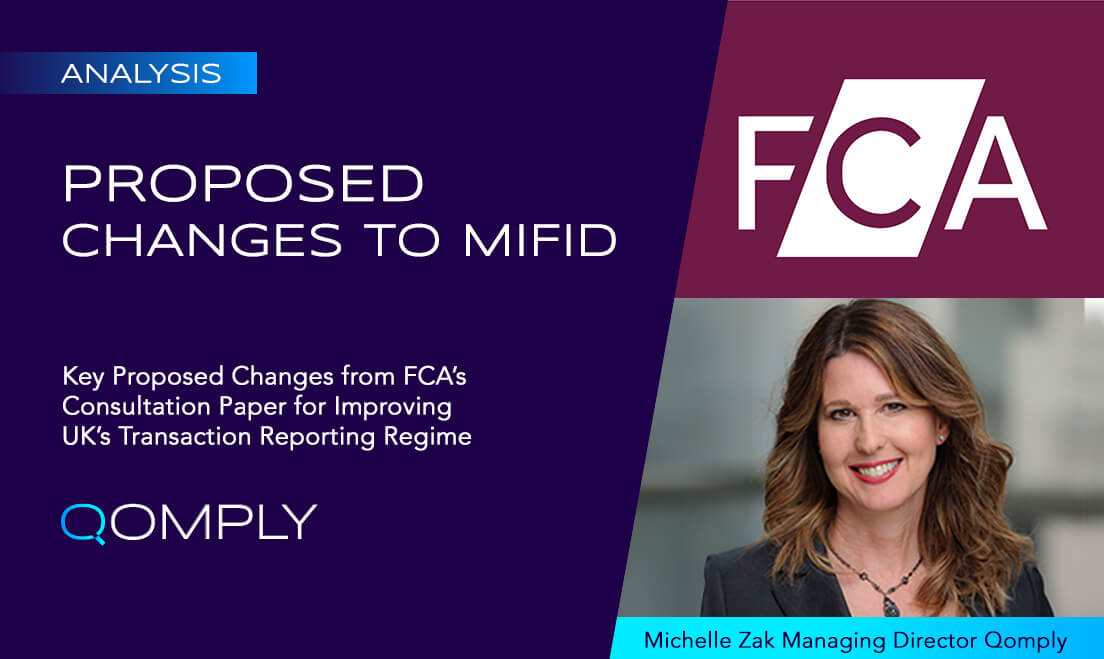
    FCA Releases Proposed Changes to MiFID

    The FCA has released its long-awaited Consultation Paper (CP25/32) on Improving the UK Transaction Reporting Regime. This marks the first meaningful indication of the FCA’s direction for the next evolution of MiFID in the UK…

How Qomply Can Help

Diagnostic Tool

Quality Assurance for Transaction Reports

Transaction Report Diagnostic Auditor ensures transaction reports are right the first time. Only solution trusted by regulatory consultants.

Most comprehensive arsenal of accuracy checks in the industry mitigates regulatory risk, reduces reporting costs, and ensures operational efficiency.

MiFID, EMIR, CFTC, CSA
HKMA, SFTR, MAS, ASIC

Learn more >>>

Reconciliation for G10 Transaction Reporting

DualRec delivers intelligent, automated reconciliation across EMIR, CFTC, CSA, and other G10 regimes, giving firms immediate visibility into reporting completeness, open positions, and breaks.

Learn more >>>

UPI Finder

Instantly Locate the UPI for an ISIN

Qomply’s UPI Finder instantly identifies the correct UPI from an ISIN, reducing manual effort and minimising errors.

Learn more >>>