Why Technology is Redefining Transaction Reporting Reconciliations
 Author:
Sophia Fulugunya
Author:
Sophia Fulugunya

Director of Transaction Reporting
21 April 2026
Across global reporting regimes, reconciliation has become one of the clearest indicators of whether a firm truly has control over its regulatory reporting.
On paper, the requirement is simple. Firms must ensure that what they report to trade repositories is complete and accurate, and that it aligns with internal records and counterparty data.
In practice, this is where many firms struggle.
Data is fragmented across systems, enriched through multiple processes, and reported under tight timelines. As volumes increase and regulatory focus on data quality intensifies, manual reconciliation approaches are no longer sufficient.
Leading firms are responding by treating reconciliation as a technology enabled control rather than an operational task.
From Accuracy Requirement to Control Framework
There is an important distinction between MiFID transaction reporting and G20 derivatives reporting.
Under MiFID, RTS 22 Article 15(3) explicitly requires firms to reconcile internal records against ARM data and, where relevant, data samples provided by the National Competent Authority.
Under dual sided derivatives reporting regimes such as EMIR, reconciliation operates on two distinct but complementary levels.
First, there is daily counterparty reconciliation within the trade repository. This is referred to as pairing and matching. Both sides of a trade are compared, and key fields must align within defined tolerance thresholds. This process highlights mismatches between counterparties and is a core regulatory control.
Second, there is periodic reconciliation performed by the firm against its own reporting. This is designed to identify completeness breaks, such as trades that exist internally but have not been reported, or trades present in the trade repository that are not reflected in internal records. While data mismatches may also be identified, the primary objective is completeness rather than field level alignment.
This second layer is where firms are most exposed. Pairing and matching is performed automatically by trade repositories, but responsibility for completeness sits firmly with the reporting firm.
The diagram below illustrates how these two layers of reconciliation operate in practice and how they work together to form a robust control framework.
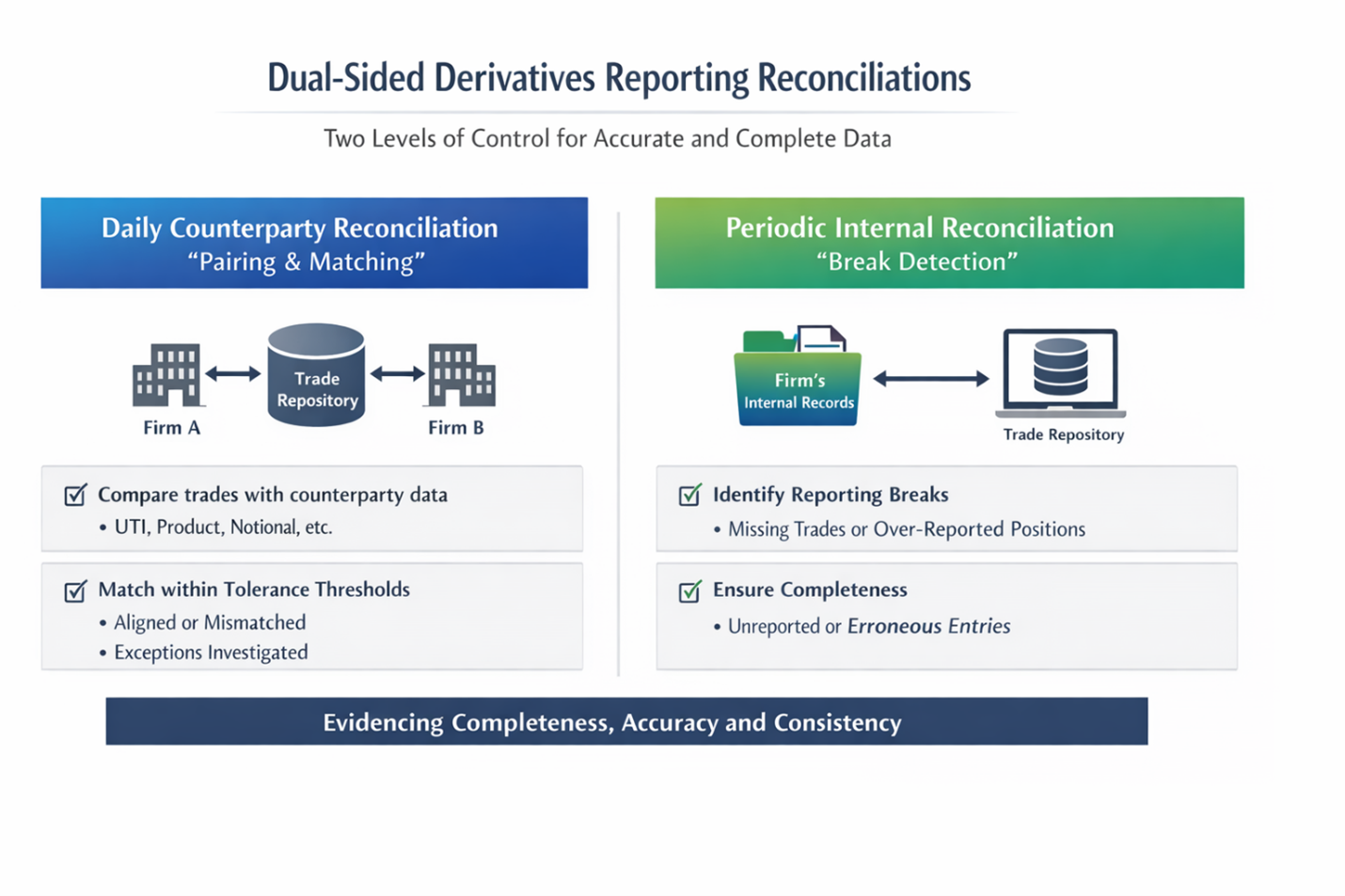
Across all regimes, regulators expect firms to demonstrate that reported data is complete, accurate and consistent. Reconciliation, across both pairing and matching and periodic controls, is the primary mechanism for evidencing this.
Where Traditional Approaches Fall Short
In many firms, reconciliation processes have evolved rather than been designed.
Spreadsheets are layered over time. Different teams reconcile different datasets in different ways. Critical knowledge sits with individuals instead of within controlled systems.
The result is a framework that is difficult to scale and even harder to evidence.
Typical risks include missed discrepancies, delays in identifying reporting issues, limited visibility over reconciliation status and reliance on manual intervention to explain outcomes.
These are precisely the areas regulators focus on during supervisory reviews.
What Leading Firms Are Doing Differently
Firms that are ahead of the curve are redesigning reconciliation as a structured control framework rather than a series of processes.
Data submitted to trade repositories and that from internal systems is ingested and standardised automatically, removing manual handling and reducing transformation risk.
Reconciliation is rules based and applied consistently across large datasets, ensuring objective outcomes and improving accuracy.
Exceptions are identified quickly and managed through structured workflows with clear ownership, prioritisation and accountability.
Each step is recorded, creating a complete and accessible audit trail without the need for manual reconstruction.
Reconciliations are performed frequently, enabling early identification of issues rather than allowing discrepancies to accumulate over time.
Why Automation Changes the Outcome
Automation does more than improve efficiency. It strengthens the control environment.
Firms gain greater confidence in reported data. Issues are identified earlier and resolved faster. Dependence on individuals is reduced and processes become consistent and repeatable.
Over time, this leads to a lower cost of compliance and a stronger ability to respond to regulatory scrutiny.
5 Warning Signs Your Reconciliations Are Not Fit for Purpose
- Reconciliations take too long to evidence
If demonstrating what was reconciled requires pulling together multiple spreadsheets or inputs, the control is not truly robust. - Breaks are identified late
Delays in identifying breaks increase regulatory risk and suggest a lack of timely control. - Matching logic is inconsistent
If different teams apply different rules, outcomes become subjective and difficult to defend. - Exception management is informal
If breaks are tracked in emails or offline logs, there is limited visibility and accountability. - There is no single source of truth
If reconciliation data is fragmented across systems, firms cannot demonstrate control with confidence.
These are early warning signs that a reconciliation framework needs to evolve.
The Direction of Travel
Regulators are increasingly focused on how firms evidence data quality.
The expectation is no longer that reconciliations are simply performed, but that they are demonstrably effective.
Firms relying on manual approaches will find it increasingly difficult to meet this standard. Those adopting scalable, technology led solutions will be better positioned to respond.
Where Qomply Fits In
Qomply helps firms modernise reconciliation across global reporting regimes.
It enables firms to bring together data from multiple sources, apply consistent matching logic and manage exceptions in a controlled and transparent way.
With clear audit trails and accessible reporting, firms can evidence their controls with confidence.
Conclusion
Reconciliation is one of the clearest signals regulators use to assess whether a firm is in control of its reporting.
Firms that treat it as a core control, supported by the right technology, will be in a far stronger position to demonstrate data quality and maintain regulatory confidence.
Key Takeaways
- Reconciliation is now a core regulatory control, not just an operational task, and is central to proving data quality.
- The biggest risk sits in completeness, with firms responsible for identifying missing or extra trades beyond automated matching.
- Manual, fragmented approaches do not scale and create auditability, consistency, and oversight challenges.
- Technology-led reconciliation enables consistent rules, faster issue detection, and clear audit trails, strengthening regulatory confidence.